

This time, we'll focus specifically on the body shape of the Gibson SG.
The SG was released in 1961 as a model change of the Les Paul. Initially, it was called the Les Paul SG because it was still under contract with Les Paul himself. However, while the Standard and Junior models had the Les Paul logo, the Special model did not. Around late 1963, the name changed to SG and the Les Paul logo disappeared. Later, around 1966, the pickguard was changed to what is called a large pickguard. There are also many other specification changes to the hardware depending on the year.
Similarly, there are differences in the body shape and neck joint. At first glance, all the models from different eras may look the same, but if you look closely, you can't help but be impressed by how different they are!
The SG is easy to play, comfortable to hold, and lightweight. And yet it has a rich bass sound.
It is undoubtedly a masterpiece that made a significant impact on the guitar industry in terms of both sound and design.
The SG features a contoured finish called beveled contouring applied to the entire edge of the body.
Now let's compare the differences in beveled contours across different eras!
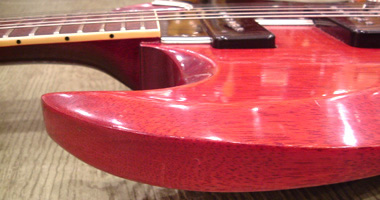
This guitar was made in 1961. It has very sharp, angular lines. It looks like it could start rocking out at any moment.
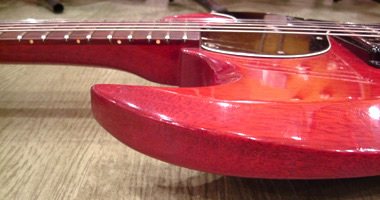
This one is from 1964. You can see that the angle is slightly less pronounced compared to the 1961 model.
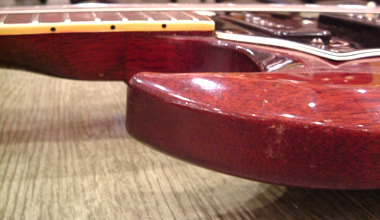
This guitar was made in 1967. The beveled contour on the body edge has become rounded and appears slightly blurred.
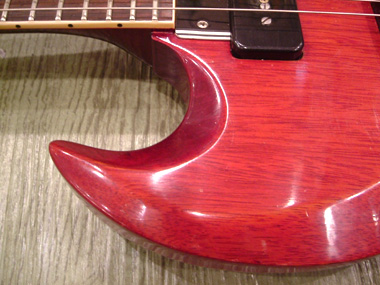
This is the cutaway section from a 1961 model. The sharp, pointed lines are truly beautiful.
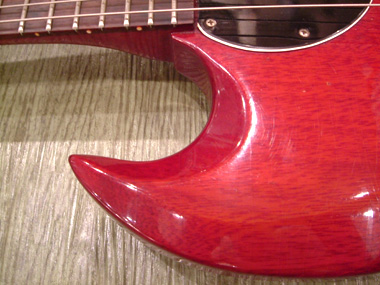
This is the cutaway section from a 1964 model. It's slightly more rounded than the 1961 model. The beveled contour area is also slightly smaller compared to the 1961 model.
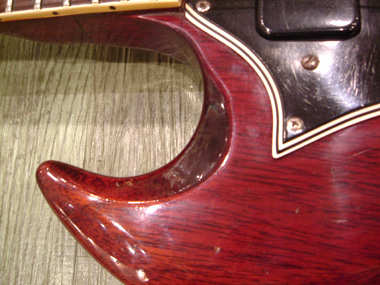
This is the cutaway section from a 1967 model. Compared to the 1961 and 1967 models, the body edges are more rounded, and the beveled contour area is considerably smaller.
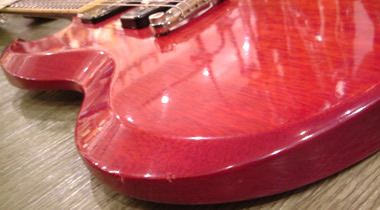
This is the elbow contour section from a 1961 model. It features sharp, angular edges. It gives a sharp and slim impression. The surface area of the cut is also slightly larger than average.
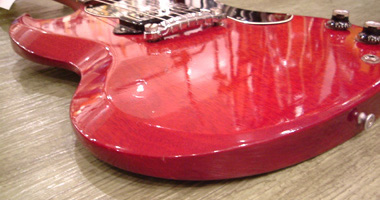
This is a 1964 elbow contour. Compared to the 1961 model, the edges are slightly less sharp. The surface area is about the same as the 1961 model.
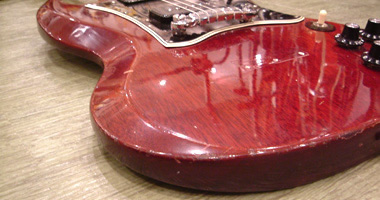
This is an elbow contour from 1967. Compared to the 1961 and 1964 models, it's even less sharp and has a smaller cutting surface area.
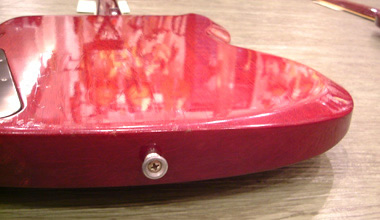
This is a beveled contour near the endpin from a 1961 model. The contour extends all the way to the endpin, and the angle is sharply machined.
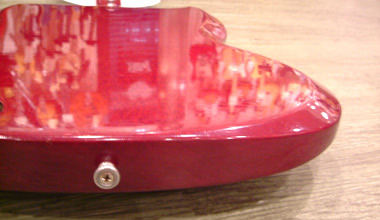
This is a beveled contour near the endpin from a 1964 model. Compared to the 1961 model, the contour is shorter and does not reach the endpin. The surface area is also slightly smaller.
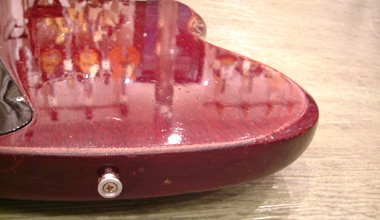
This is a beveled contour near the endpin from a 1967 model. It is even shorter and has a smaller beveled surface area than the one from the 1964 model.
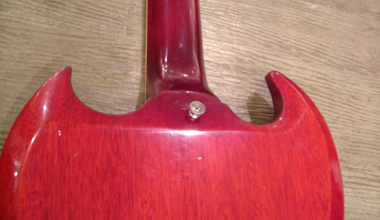
This is the back joint area and the "horn" section of a 1961 model. The finish is very smooth, and the "horn" is sharply pointed. The beveled area around the strap pin is also large, making it look almost like a through-neck design.
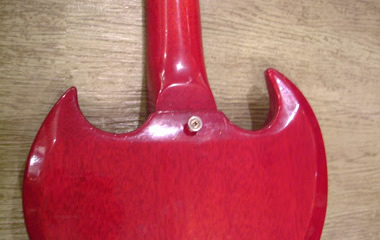
This is the back joint area and horn section of a 1964 model. Compared to the 1961 model, the beveled contour area of the cutaway is smaller. The angle of the bevel is also not as pronounced as on the 1961 model. The beveled area around the strap pin is narrower.
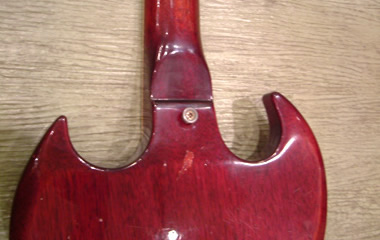
This is the back joint area and the horn section of a 1967 model. The shaping of the horn section has become less refined, slightly diminishing its sharpness. The beveled contour on the cutaway section has hardly been modified.
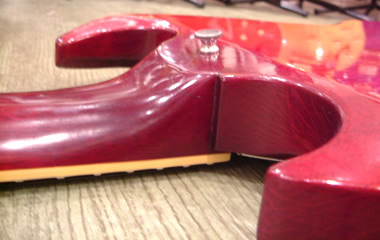
This is the joint section from a 1961 model. Can you see how incredibly smooth the finish is, with the mahogany body material overlapping the heel of the neck? It's such excellent craftsmanship that it wouldn't be an exaggeration to call it heel-less.
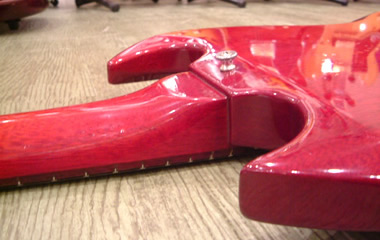
This is the joint section from a 1964 model. The mahogany on the heel, which was visible on the 1961 model, is missing. You can tell it's a set neck at a glance.
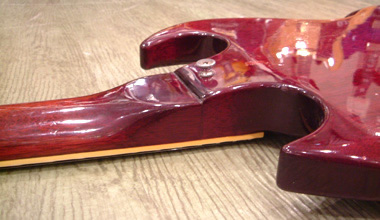
This is the joint section from a 1967 model. Compared to the 1961 and 1964 models, it looks like a completely different guitar. The heel is longer and protrudes, and the shape is also different.
