
![[Report] A Deep Dive into Led Zeppelin Vol. 1: "JP Les Paul & Amp Settings That Nobody Knew" by Jimmy Sakurai](http://global.ikebe-gakki.com/cdn/shop/articles/jimmy01_e1f73cd5-511c-4af4-ab4f-56d5f88a87b0.jpg?v=1782288301&width=1600)

Hello everyone! I'm Angus Ogawa, one of the people behind the Ikebe website! Nice to meet you. I'd like to share an archive of a report I wrote in the past. This article was published 10 years ago, in January 2015. It's about Jimmy Page's Les Paul and amp settings, as described by Jimmy Sakurai, who is now active on the world stage. I still remember being quite shocked when I interviewed him at the time. The current equipment used for comparison in the study group feels dated, but I think the way of thinking about pursuing sound is very universal. Please take a look. (Comment added on June 12, 2025)
December 27, 2014, Studio Ribore Part 2, Studio 101. "How can the sound of Led Zeppelin guitarist Jimmy Page be recreated...?" Jimmy Sakurai, the world's leading Led Zeppelin tribute musician, who has completely recreated Jimmy Page's sound through his unparalleled spirit of inquiry and is even recognized by Jimmy Page himself, will delve into the secrets of that sound!
The insatiable quest for Jimmy Page explodes here.
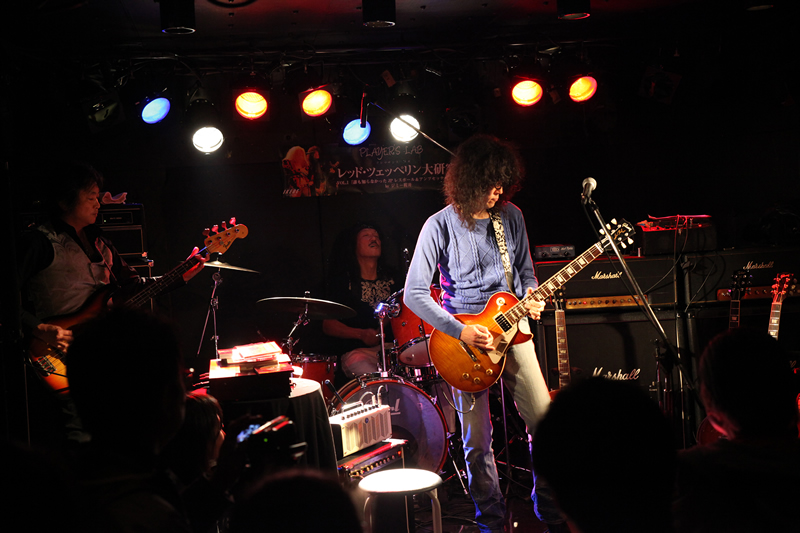
Jimmy Sakurai appeared on stage with his close friends Saito (bass) and Dick Kitahata (drums) from his new unit "JimmySAKURAI Plays ZEP," which he formed for his activities in Japan.
With Dick Kitahata's drums as the signal, the performance of "We're Gonna Groove" began. Jimmy Sakurai's controllable Les Paul and Marshall 1959 amp produced sharp tones that blended with the sweet distortion of a vintage VOX Tone Bender. It was reminiscent of the legendary performance at the Royal Albert Hall, which can be seen on the LED ZEPPELIN DVD.
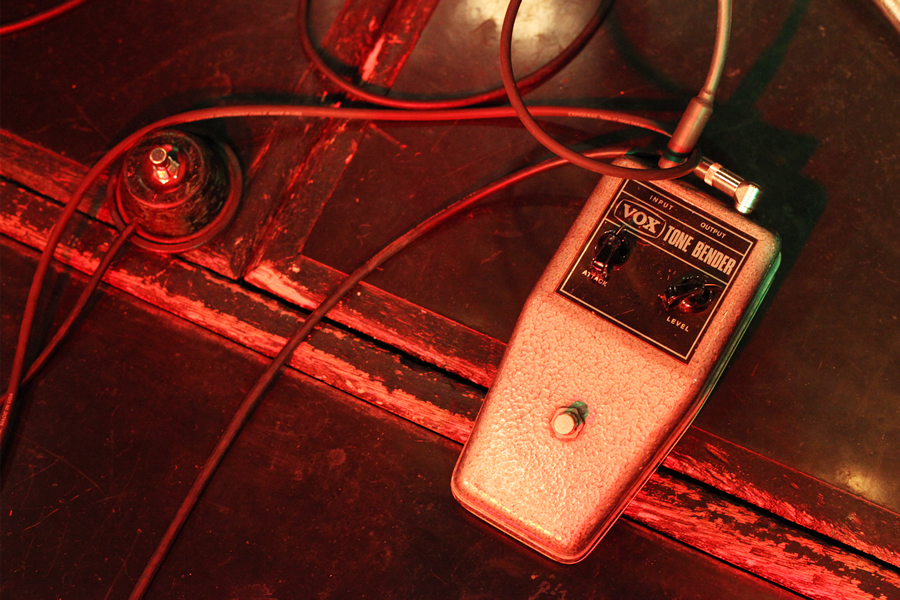
By combining an overdriven Marshall 1959 with a VOX Tone Bender, you can achieve a thick, sweet tone when you turn up the guitar's volume, and a crystal-clear clean tone when you turn down the volume.
The essence of the Jimmy Page sound
There are many secrets to how Jimmy Page plays those iconic phrases from his Les Paul, achieving "that sound." One of them is the guitar's tone control. From pickup selection to volume balance, meticulous adjustments create a wide range of tones.
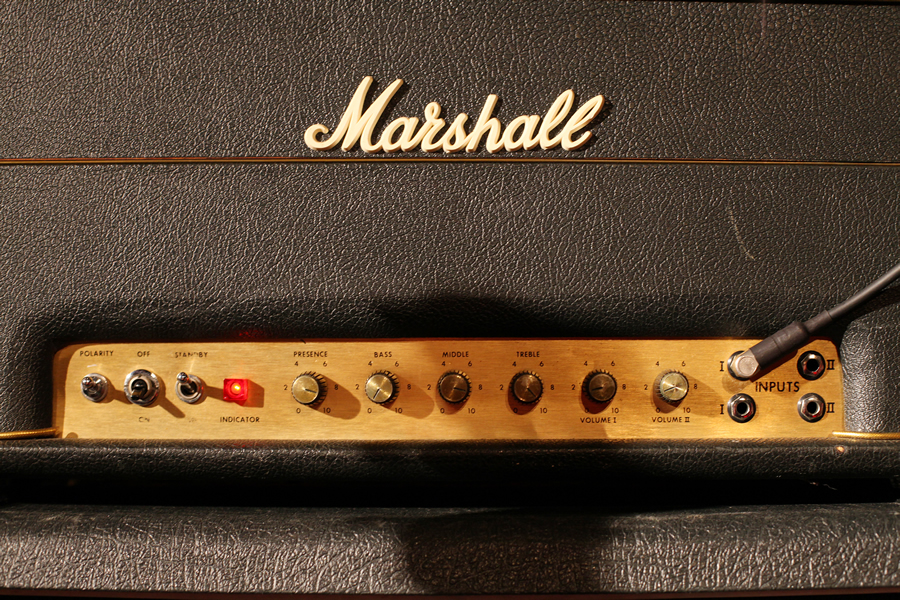
The amp settings were treble 10, presence 9, middle 8, and bass 0. A vintage ECHOPLEX owned by Jimmy Sakurai was used as a booster, cutting the low frequencies and emphasizing the high frequencies.
To showcase the band's ensemble, Jimmy Page's sound is fundamentally based on a "low-cut" filter. However, even with the low-cut filter in place, the resonance of the Marshall cabinet compensates for the lack of sufficient low-frequency power.
The guitar's pickup configuration is based on a mixed tone using the front and rear pickups. By controlling each volume and tone, the guitar's tone can be changed depending on the song being played. The
amplifier settings are kept as unchanged as possible, and the Jimmy Page sound is recreated through Jimmy Sakurai's exquisite control of the guitar itself.
The study group will proceed based on this guitar control method!
How close can we get using the current equipment?

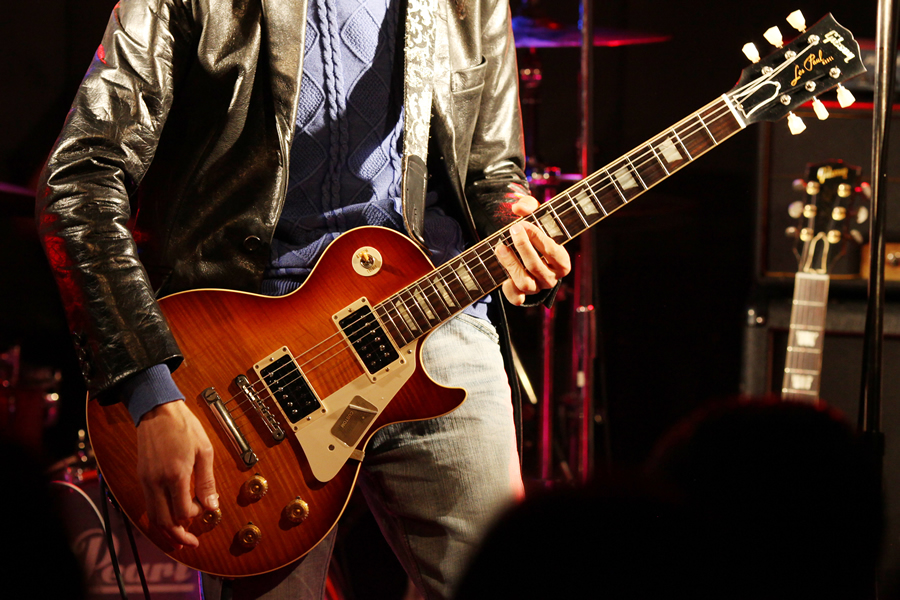
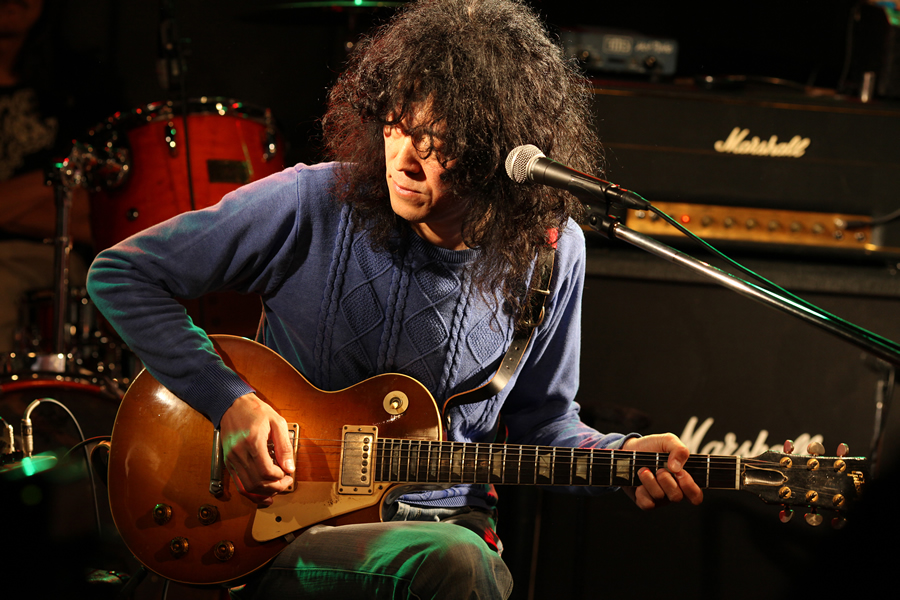
A demo performance of "Rock n' Roll" was given using a current Historic Collection Les Paul equipped with the "GRINNING DOG / Mr.Jimmy Pickup set." It was surprisingly close to the Jimmy Page sound, reproducing a clean, unadulterated mixed tone.
Next, for comparison, he switched to a 1959 vintage Les Paul owned by Jimmy Sakurai, equipped with the "GRINNING DOG / Mr. Jimmy Pickup set," and performed "Rock n' Roll" again with the same settings. As expected of a vintage Burst, considered the pinnacle of guitars, the tone had a rounded, smooth, and mellow quality, perhaps influenced by the wood, construction, and changes over time, while still possessing an outstanding presence. He then
switched to a current standard Historic Collection Les Paul and performed "Rock n' Roll" again. The "Custombucker" pickups installed in recent Historic Collection models have a lower output compared to past models, but compared to them, they have more power, and I felt a modern, vibrant nuance that differed from the Jimmy Page sound of yesteryear.
A thorough analysis of "The Song Remains the Same" by Led Zeppelin!
Next, Jimmy Sakurai revealed how he created the sounds for "Rock n' Roll" and "Celebration Day" using audio from "Led Zeppelin: The Song Remains the Same"!
“Rock n' Roll” Sound Making
- Pickups in mixed position
First, the basic principle is to cut out unnecessary frequencies from the state where both the rear and front pickups' volume and tone are set to 10.
Set the rear pickup's volume to 10 and the tone to 0-3.
The Jimmy Page Les Paul sound you hear in this song is played in the mixed position of the front and rear pickups.
Jimmy Sakurai actually put his Les Paul in the mixed position and demonstrated how Jimmy Page set up his guitar by controlling the tone.
Incidentally, the part where he plays using only the rear pickup was the guitar solo.
“Celebration Day” Sound Making
The opening guitar riff is played in the mixed position. It sounds similar to the sound of the rear pickup, but that's because the volume of the front pickup was lowered, making it sound more like the rear pickup. From the latter half of the riff, he switches to the rear pickup.
In this way, you can see that Jimmy Page uses a variety of tones by combining pickups and tone controls, employing various creative techniques to express the deep, immersive world of Led Zeppelin's studio albums in live performances.
From this, it can be said that being able to distinguish and use different settings is a crucial point in producing the Jimmy Page sound.
The key to the Jimmy Page sound
- Use the amplifier's equalization to bring out all the desired frequency ranges.
- The frequency range you want to cut is done by adjusting the settings on the guitar itself.
- The pickups used will be the "GRINNING DOG / Mr.Jimmy Pickup set".
- To get closer to the original artist, appearance is very important! Therefore, he pays close attention to the guitar's parts. (For example, 70s Grover gold tuners, a pickguard, and a DMC escutcheon switch.)
Jimmy Sakurai's custom-made TOKAI LS-JIMMY
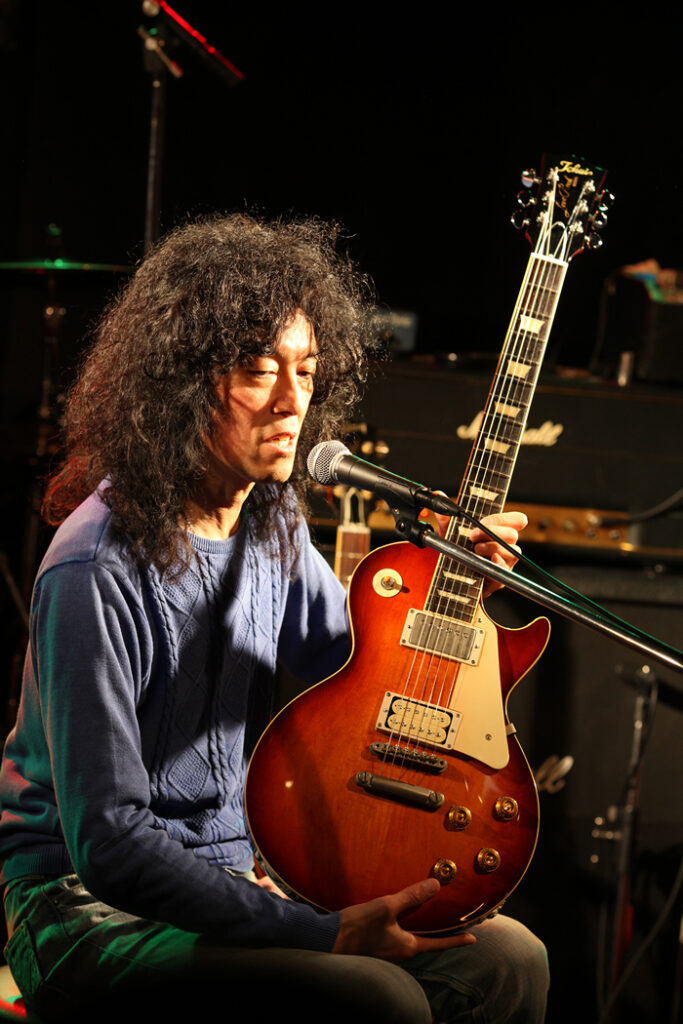
Here's an introduction to the meticulously crafted TOKAI LS-JIMMY!
The TOKAI LS-JIMMY is a guitar meticulously designed and completed by Jimmy Sakurai himself, who oversaw everything from material selection to the final product.
He thoroughly analyzed his own 1959 vintage Les Paul. The beautifully striking arched top is carefully finished by skilled craftsmen, and the body is finished with a deliberately uneven paint job to recreate the fading characteristic of vintage guitars.
Of course, lacquer paint is used for the finish. As you use it, its texture and character will increase, making it a guitar you can enjoy for many years to come.
The neck is also made from a very high-quality one-piece mahogany and is joined using a deep-joint set-neck method with a 4.5-degree angle. The headstock surface is laminated with 1mm maple, creating a construction method similar to Jimmy Sakurai's 1959 vintage Les Paul while also increasing its strength.
The pickups are, of course, the "GRINNING DOG / Mr.Jimmy Pickup set". DMC parts are used without reservation.
Also noteworthy is the double cream finish, with a covered front pickup and an open rear pickup.
This is a guitar with an outstanding presence, overflowing with Jimmy Sakurai's love for Jimmy Page, completed with no compromises and meticulous attention to detail.
A deep commitment to expressing tone.
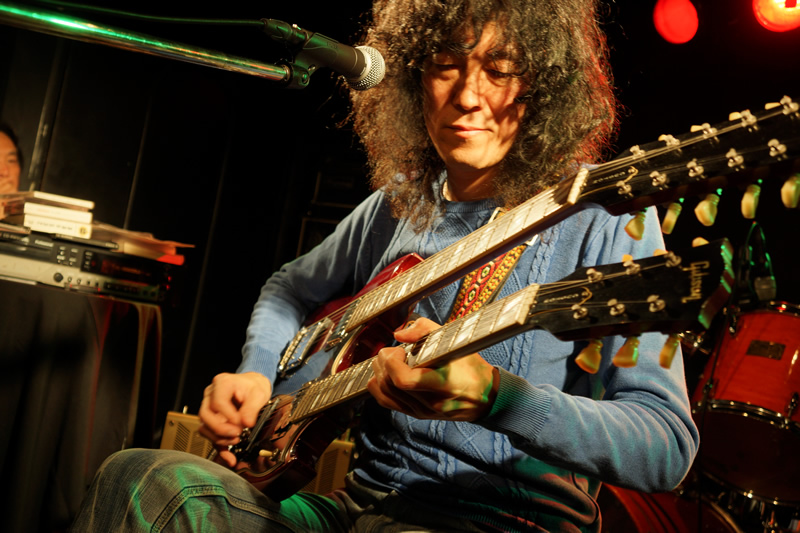
And speaking of Jimmy Page, you can't talk about him without mentioning the Gibson EDS-1275, so we thoroughly analyzed the BBC live version of "Stairway to Heaven" using it!
What is BBC Live?
This recording is from a performance at the Paris Theatre in London on April 1, 1971.
The studio album "LED ZEPPELIN IV," which includes this song, was released on November 8 of the same year, with recording taking place from December 1970 to May 1971. The song's first live performance was at the Ulster Hall in Belfast on March 5, 1971, suggesting that Jimmy Page was still experimenting with the song during the BBC live performance. The
guitar arrangement of "Stairway to Heaven" in this BBC live performance is simple, but the overall arrangement has a strong melancholic feel.
The key to the BBC live performance of "Stairway to Heaven" lies in the timing of the switch to the 12-string side.
In the classic "Led Zeppelin: The Song Remains the Same," the switch to the 12th string occurs after the first verse and when moving to the G position. In the BBC version, however, the guitar is still playing on the 6th string at that point, and the switch to the 12th string occurs when Robert Plant begins the second verse.
This example shows that Jimmy Page is constantly experimenting to find the right guitar sound for each song.
Jimmy Sakurai also explained how sound shaping is possible by utilizing the structure of the Gibson EDS-1275 in combination with the neck selector switch.
When the neck selector switch is in the middle position, both the 6th and 12th strings produce sound, resulting in a phased sound that gives the impression of reduced power. He introduced playing techniques that take advantage of this characteristic. He also demonstrated a sound approach that utilizes the feedback generated by the resonance of the 6th and 12th strings.
By analyzing it in this detail, we can catch a glimpse of Jimmy Page's deep commitment to expressing tone.
You can create the Jimmy Page sound at home.
Next, we'll introduce sound-making techniques for playing at home. This is especially recommended for those who know that specialized equipment is necessary but can't easily afford it! You can recreate the sound with readily available equipment!
Jimmy Sakurai used a current-model, standard-spec Historic Collection Les Paul guitar and explained how to recreate the sound at home by combining it with a Marshall DSL-15C amplifier and a BSM treble booster.
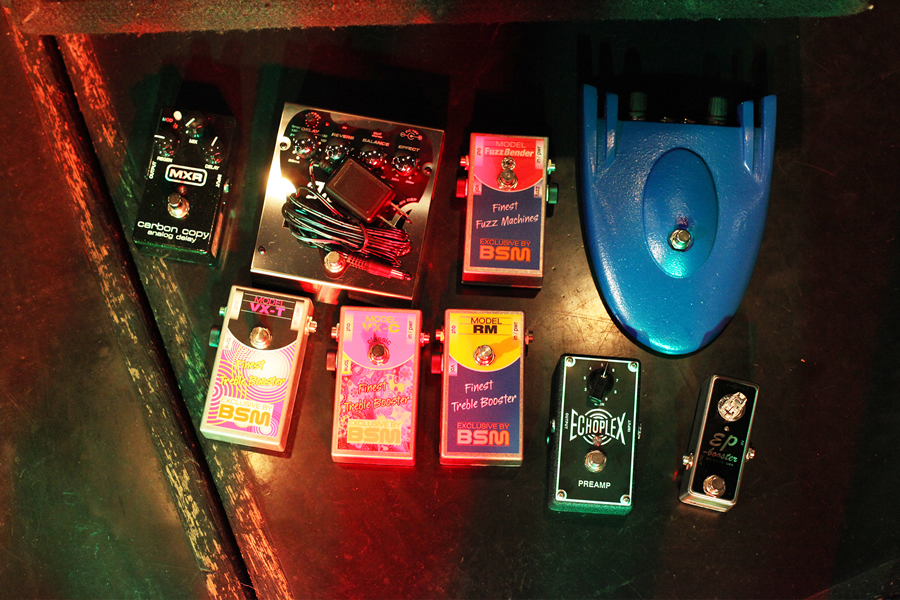
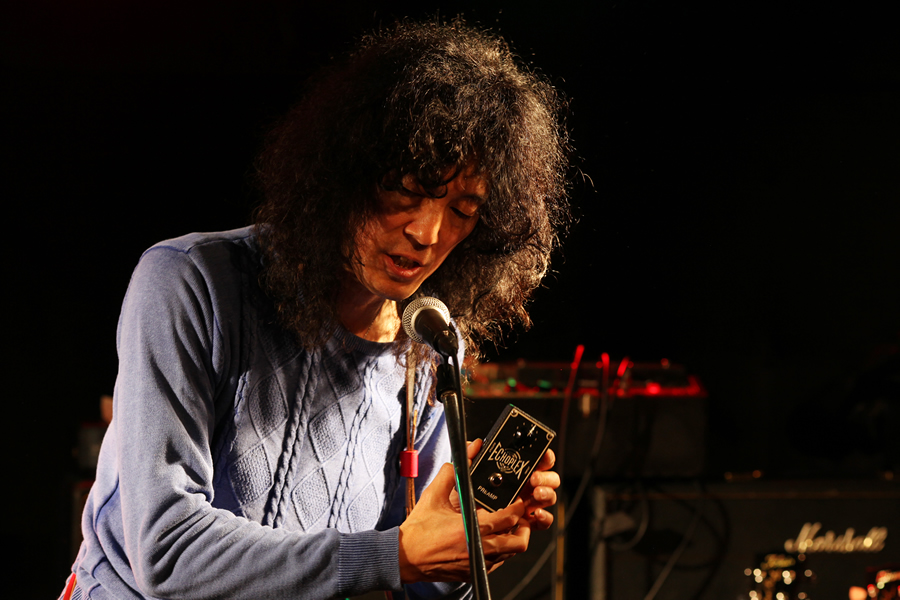

On the amplifier side, use the crunch channel and set it to emphasize the high frequencies.
Then, use a treble booster effect pedal.
By using a treble booster, you can add definition and richness to the tone when the volume is turned down, improving clarity and creating an effective tone.
Comparing the treble boosters used
BSM / VX-C: Recreates the VOX treble booster. This one has lower gain.
BSM / VX-T: Recreates the VOX treble booster. This one has higher gain.
If your goal is to "recreate Jimmy Page's sound," the BSM/VX-C with its lower gain would be a good match. However, the BSM/VX-T has the advantage of emphasizing the mid-range frequencies, allowing for a wider range of tonal adjustments.
Next, I connected a current Historic Collection Les Paul equipped with the "GRINNING DOG / Mr.Jimmy Pickup set" directly to a Marshall DSL-15C amp and set the amp to the lead channel. This allowed me to produce a Jimmy Page sound without using a treble booster, and I was able to experience the characteristics of the "GRINNING DOG / Mr.Jimmy Pickup set."
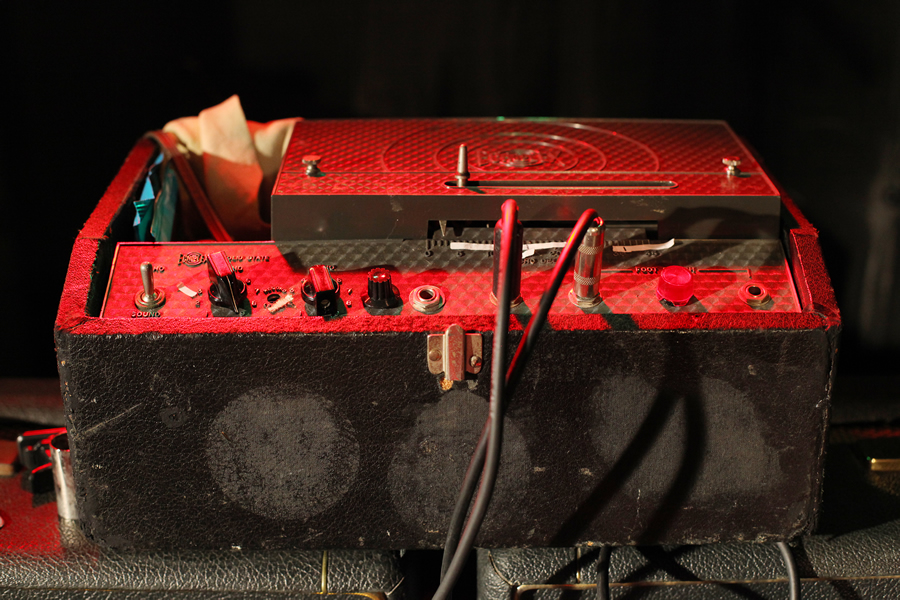
Also, when talking about Jimmy Page, the ECHOPLEX is an indispensable element. Jimmy Page used the echo section, but he also used the ECHOPLEX's preamp section as a booster.
While the Echoplex is currently difficult to obtain, effect pedals that replicate its preamp section are available. Representative examples include the Jim Dunlop/Echoplex Preamp and the Xotic/EP Booster.
For comparison, a current Historic Collection Les Paul was connected to Jimmy Sakurai's vintage Echoplex and Echoplex Preamp, and the sound was output through a vintage Marshall 1959.
The Echoplex Preamp has a wider tonal range than Jimmy Sakurai's vintage Echoplex, allowing for higher gain settings.
Jimmy Sakurai commented, "It's well-made and can produce a sound that's close to the original. It also boosts the high frequencies, so depending on the settings, it can be used as a treble booster."
A digital modeling amplifier that closely resembles the real thing.
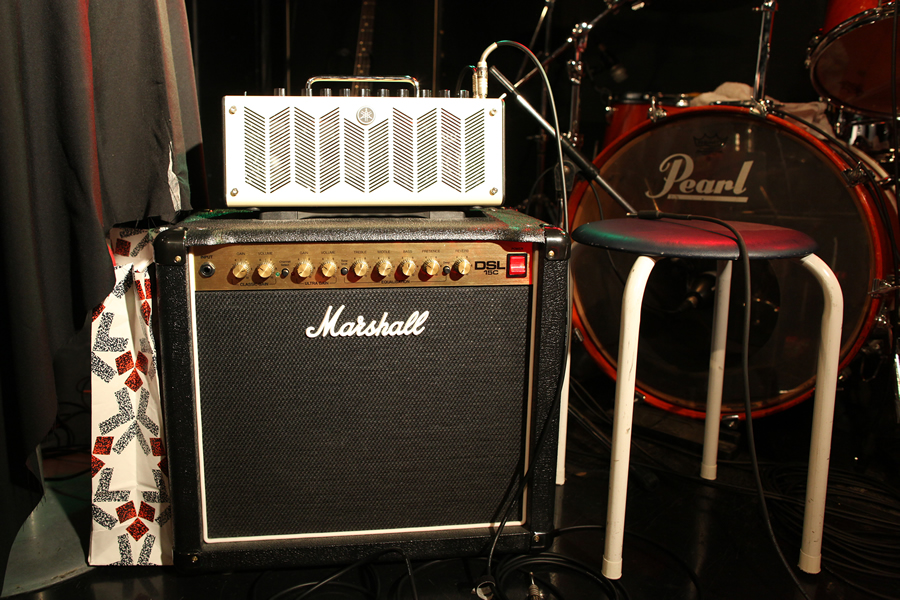
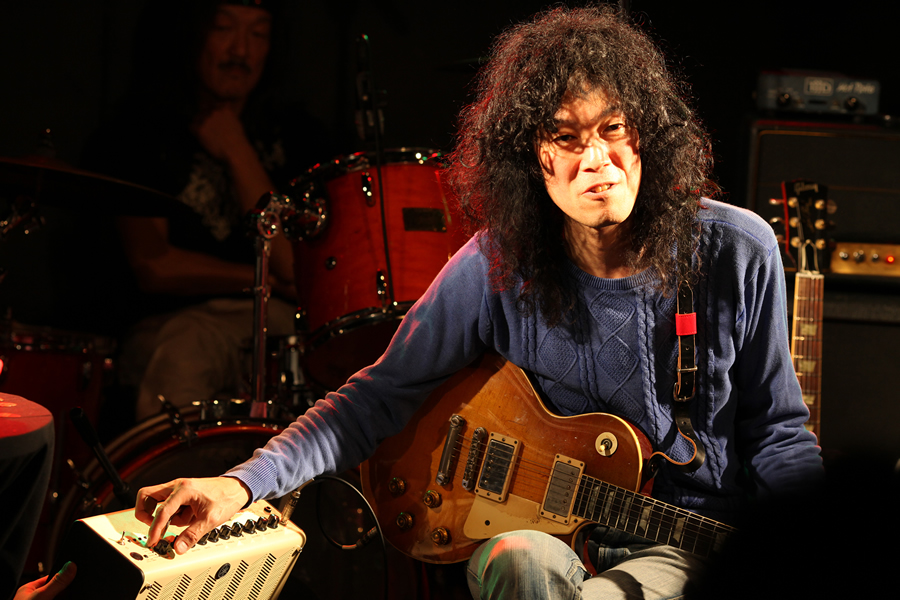
Digital modeling amplifiers are gaining popularity among enthusiasts due to their ease of use and ability to produce a variety of sounds at home. This article introduces sound-making techniques using the highly-regarded YAMAHA THR-10 digital modeling amplifier.
The amplifier simulation is set to BRIT HI mode, with Bass set to 0, Middle to 10, and Treble to 10.
In addition, the amplifier's headphone output is connected to a PA system. A current Historic Les Paul equipped with the "GRINNING DOG / Mr.Jimmy Pickup set" is connected to this modeling amplifier, and a band ensemble performance is conducted. The
surprisingly punchy sound of "Immigrant Song" surprised the audience!
Even Jimmy Sakurai was impressed!
"The sound is good enough to be used in a band ensemble, and it's perfect for home practice."
As an atmosphere of surprise filled the venue, Jimmy Sakurai said,
"Now, let's play some vintage equipment again."
He switched the amp to a vintage Marshall 1959 and once again performed "Immigrant Song" with the band ensemble. As expected, nothing compares to this sound! From the heavy sound pressure and the way the tone expands to the way the high frequencies pierce through, it was as if the sound was alive.
The evolution of digital modeling amps is wonderful, but at the same time, I was able to rediscover the charm of the "living sound" that analog amps possess.
The real thrill lies in being able to pursue the sound you want to produce.
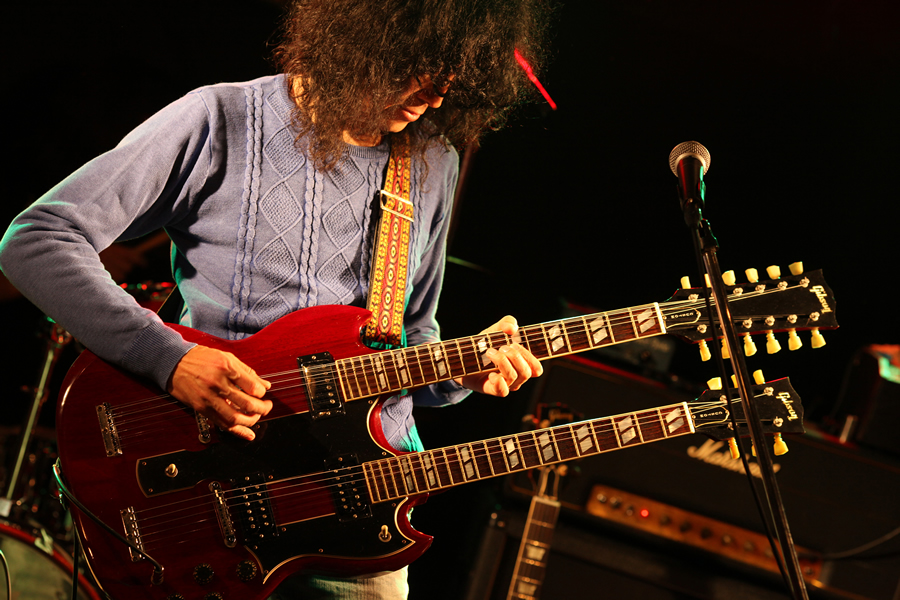
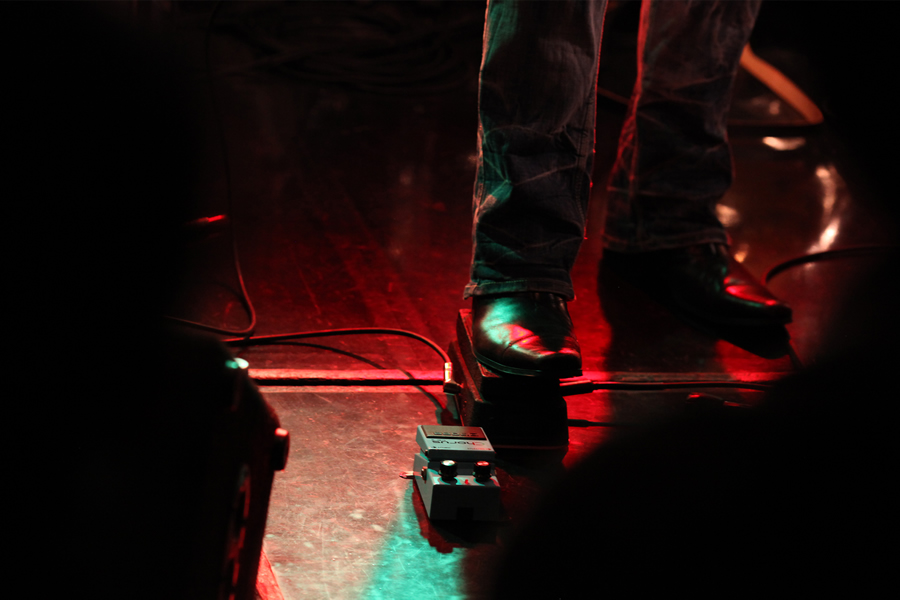
Finally, Jimmy Sakurai picked up his Gibson EDS-1275 and performed "Song Remains the Same" with the band. He pressed the wah pedal to the point where the high frequencies were emphasized, creating a trebly sound. When he strummed the guitar, it was as if "Song Remains the Same" from "The Song Remains the Same" by Led Zeppelin was brought back to life! Once the band joined in, Sakurai's passionate guitar playing exploded! As if possessed by the spirit of Jimmy Page, he recreated many of his signature moves, such as raising his right hand and wiggling his feet as he moved, thrilling the audience.
Jimmy Sakurai says there's still so much more to discover about Jimmy Page, including subtle details and specific points he hasn't discussed! We would love to see a second session to delve into even more in-depth aspects! (For those who couldn't attend this eye-opening study session, and even if this report has piqued your interest, we highly recommend experiencing it in person!!)
In this major workshop, Jimmy Sakurai spoke about the theme of "how close can you get to his sound?" and conveyed to us the meaning of "the great possibilities that can be uncovered by paying attention to the finer details, listening carefully, and moving your hands when playing the guitar."
First, try to figure out how to get as close as possible with the equipment you already have. If you feel that it's not enough, it's important to experiment by tinkering with the guitar itself, trying out different effects pedals, or changing amplifiers. When you pursue your own sound and achieve it, you will surely enjoy playing the guitar more, and you will rediscover the fun of the instrument and the charm of music.
Finally, a commemorative photo with Jimmy Sakurai and all the guests who participated! Thank you all for coming.

※This page is an English translation of an article from Ikebe Information.
